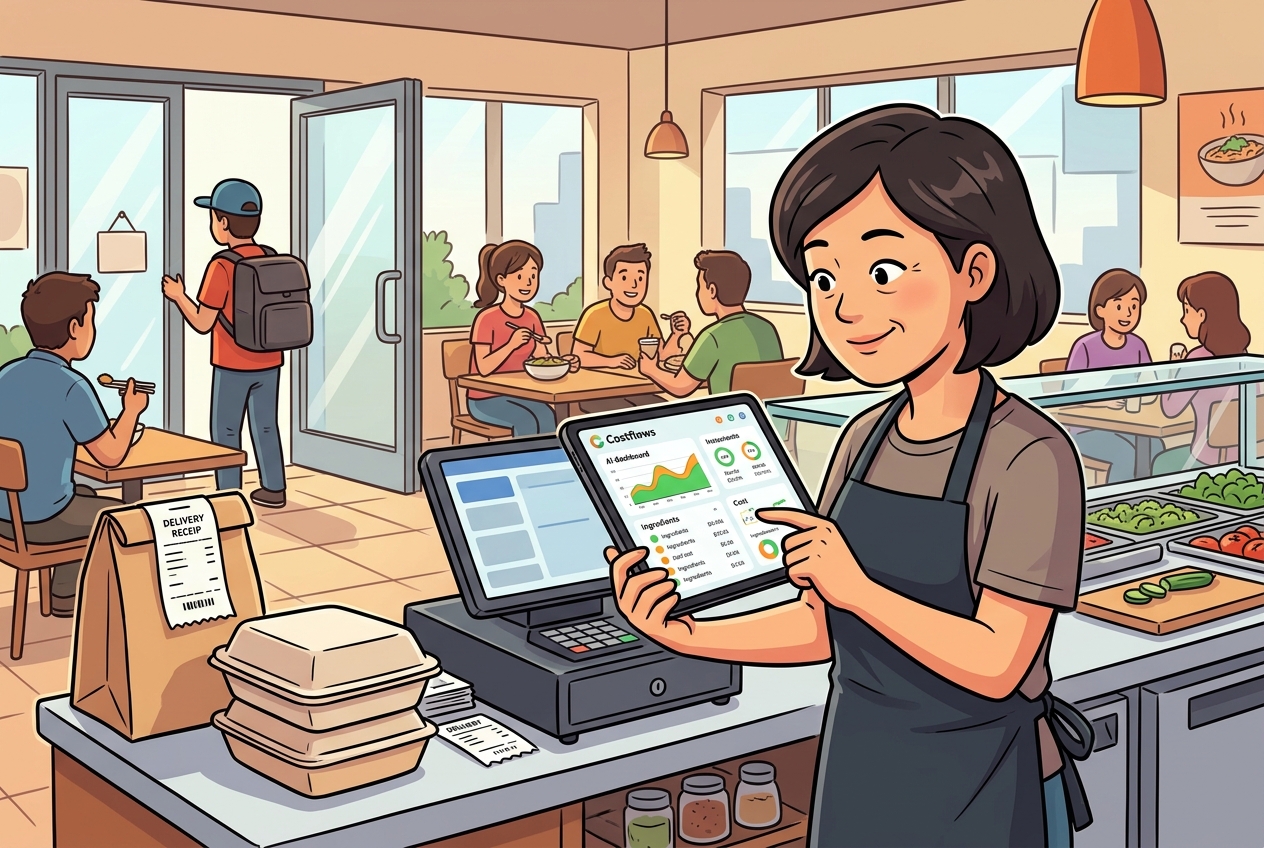
Many restaurant owners work tirelessly every day with kitchen burners constantly going, only to look at their bills at the end of the month and wonder: "Sales look great, so why am I barely making any money?"
The issue usually isn't a lack of foot traffic—it’s an imbalanced cost structure and invisible "profit leaks." If you don't know where every dollar is going, you can't effectively control costs or increase your net profit.
Today, let’s break down the benchmark cost structure for Taiwan’s F&B industry and reveal how data-driven management can help you reclaim your hidden profits!
Standard Restaurant Cost Structure Analysis (Based on $1M Monthly Revenue)
In Taiwan, a healthy monthly cost structure for a mid-sized restaurant generally looks like this:
- Food & Ingredient Costs: 30–35% (
300k–300k–350k) — The largest and most dynamic variable cost, but also the area where precise management yields the biggest savings.- Labor Costs: 25–30% (
250k–250k–300k) — Includes salaries, labor/health insurance, and overtime—making it the second-largest expense.- Rent: 10–15% (
100k–100k–150k) — A fixed cost locked in the moment you sign the lease.- Utilities (Water, Electricity, Gas): 3–5% (
30k–30k–50k) — Essential operational expenses, especially for AC in summer and kitchen output.- Marketing Expenses: 3–5% (
30k–30k–50k) — Social media ads, influencer collaborations, and promotional campaigns.- Equipment & Systems: 2–5% (
20k–20k–50k) — POS systems, equipment maintenance, and depreciation.- Miscellaneous & Consumables: 3–5% (
30k–30k–50k) — Cleaning supplies, takeout packaging, repairs, and administrative fees.- Target Net Profit: 10–15% (
100k–100k–150k) — Assuming every item above is managed to perfection.
High Revenue, Low Profit? 3 Hidden Profit Leaks
Many operators fall into a reactive cycle—only realizing they lost money when the accountant releases monthly reports, well past the window for quick adjustments. Common profit leaks include:
- Unnoticed Supplier Price Hikes: Minor price increases slip by unnoticed, quietly pushing food costs past the critical 35% mark.
- Static Menu Costing: Menus go unchanged for years, turning popular dishes into money-losers due to rising ingredient costs.
- Invisible Food Variance & Waste: Inconsistent portion control in the kitchen, expired inventory, or unrecorded waste.
How Costflows Cuts Costs and Boosts Net Profit
In the restaurant industry, every 3% reduction in food cost can boost net profit by nearly 50%! Costflows smart restaurant management system is designed specifically to address these pain points:
1. AI Invoice Recognition to Monitor Price Hikes Real-Time
No more manual Excel entry! Staff simply take a photo of supplier invoices or delivery slips, and Costflows AI automatically extracts item names and unit prices. The system tracks historical prices and alerts you immediately if costs spike, allowing you to re-negotiate or switch suppliers right away.
2. Dynamic Recipes & Menu Engineering
By integrating POS sales data with real-time purchasing costs, Costflows calculates exact theoretical costs and margins for every dish. It highlights high-margin "stars" and low-margin "losers," helping you optimize menu pricing and ingredient combinations.
3. Theoretical vs. Actual Inventory to Plug Waste Leaks
The system calculates theoretical remaining stock and compares it with actual physical inventory counts (Variance Analysis). Whether it’s kitchen waste, over-portioning, or unrecorded spoilage, everything becomes crystal clear.
4. Automated Workflows to Cut Administrative Overhead
By automating purchase orders, approvals, and invoice matching, manager tasks that used to take 1–2 hours daily are trimmed down to minutes. This frees up your staff to focus on guest experience and revenue generation.
Conclusion: Shift from "Gut Feeling" to Data-Driven Management
Running a restaurant shouldn't be a game of chance. To break free from the "high sales, zero profit" curse, move away from reactive reviews and start tracking dish costs and invoices in real time.
Let Costflows serve as your digital financial advisor, saving you 3–5% in unnecessary expenses and bringing your lost net profits back where they belong!
Frequently Asked Questions
Q1: What is a healthy food cost percentage? What should I do if it exceeds 35%?
A: A healthy food cost percentage for Taiwan's F&B industry is typically between 30% and 35%. If it goes above 35%, start with a "menu engineering analysis." Check if top-selling items have low margins, if suppliers have raised prices, or if there is excess waste and poor portion control in the kitchen.
Q2: How can a restaurant accurately calculate dish costs and true margins?
A: Accurate dish costing requires setting up a "Bill of Materials (BOM)" standard recipe, multiplying ingredient weights by unit costs. Manual calculations are time-consuming and fail to reflect price fluctuations. Systems like Costflows connect real-time purchasing costs with POS sales data to dynamically calculate up-to-date margins.
Q3: Will adopting Costflows increase the workload for on-site staff?
A: Not at all—it actually reduces administrative burden. Costflows features AI invoice recognition, so staff only need to take a quick photo of delivery slips or invoices to log items and reconcile accounts. No tedious manual data entry required, saving store managers and back-office staff 1 to 2 hours every day.
.png)

訂閱最新消息
不要錯過任何餐飲的資訊