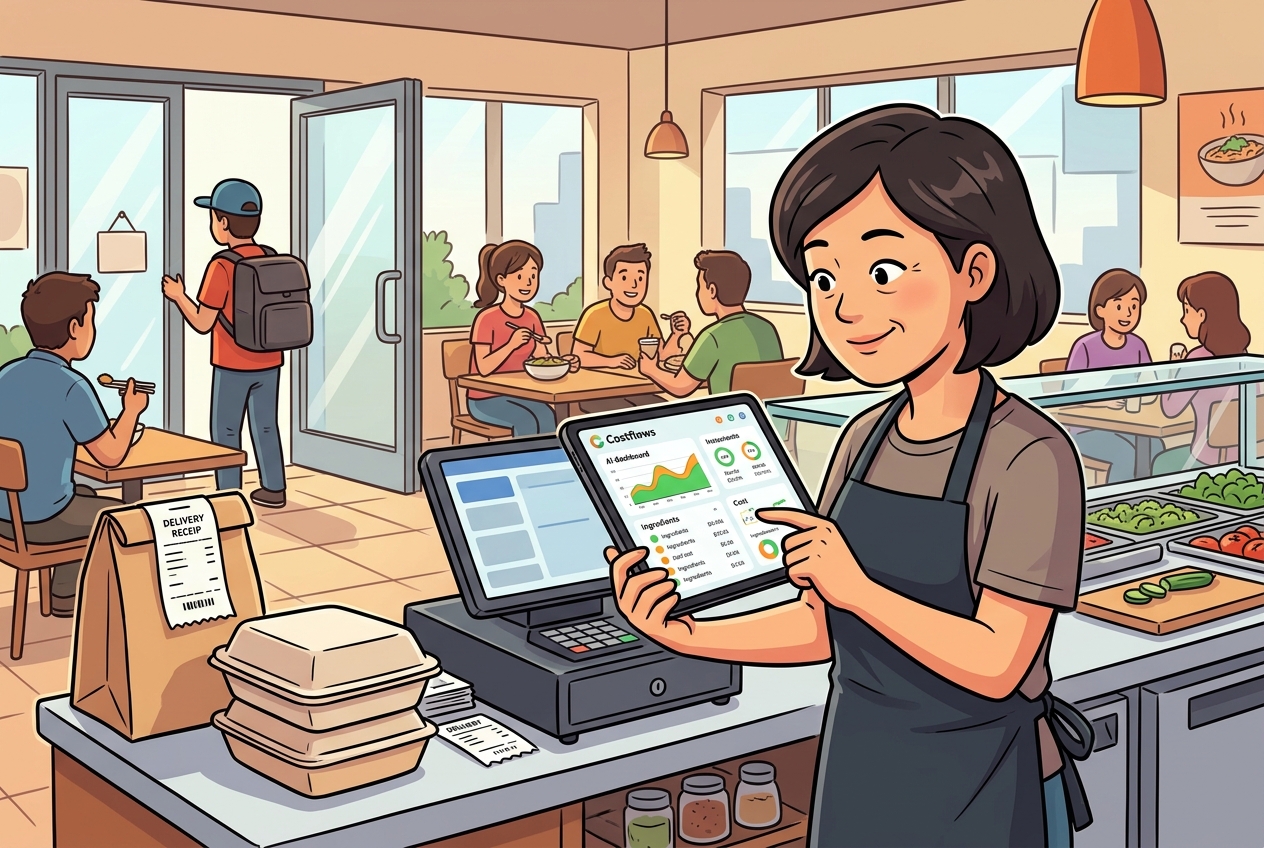
The biggest headache in multi-unit restaurant management isn't seasonal sales dips—it’s when every location in your group buys, tracks, receives, and records wastage in their own way. When purchasing data is scattered across WhatsApp chats, paper receipts, custom Excel sheets, and photos on your staff's phones, you might think the only issue is slow operations. In reality, your margins are being quietly eaten away by missed orders, wrong vendor prices, duplicate POs, and inaccurate inventory. This guide is not about abstract purchasing concepts. It's about how to get your front-line staff, back office, and management onto the exact same data chain.
Multi-Unit Purchasing Chaos Isn't From a Lack of Hard Work
Many growing F&B brands start by relying on gut feeling and experience. Store managers handle restocking, the kitchen orders by habit, purchasing assigns orders based on supplier relationships, and accounting matches invoices at month-end. When you only have a couple of stores, you might get away with this. But as you add locations, the cracks open up fast.
The most common issue is inconsistency: ordering the exact same item under different names at different stores, or a vendor charging different prices to different locations. On paper, you have a purchasing policy; in reality, you just have a pile of spreadsheets created after the fact. By the time management notices food costs spiked, weeks have passed, and you’ve missed the window to negotiate.
To make things harder, departments often hold separate versions of the data. The kitchen only cares if they have enough stock for today, the manager wants to rush the next order, accounting just wants a complete paper trail, and the owner is trying to look at overall margins and vendor performance. Without a collaborative process, everyone is working hard, but no one actually has a clear view of the big picture.
True Procurement Collaboration Is More Than Just Centralized Buying
When operators hear "collaboration," they often assume it means stripping buying power from individual locations and centralizing it at headquarters. While this works sometimes, it doesn't fit every concept. Quick-service, full-service, hotpot, cafes, and central kitchens all have completely different order frequencies and price fluctuations. True collaboration isn't about rigid control—it's about standardizing rules, data formats, approval logic, and feedback loops.
In other words, collaboration shouldn't make your stores rigid; it should make every purchase trackable, auditable, and analytical. Locations can still order based on their daily needs, but the items, units, vendors, price limits, approvals, and receiving logs must feed into a single system. The value is immediate: you don't just know what you bought—you know why you bought it, who approved it, if it was overpriced, if it arrived on time, and if it ultimately turned into sales and profit.
Break Down Your Workflow to Find Where the Money Is Leaking
The reason multi-unit procurement projects fail is that brands try to digitize everything at once, causing massive pushback from front-line teams. A more practical approach is to break down your workflow into five steps:
- Requisitions: Who requests stock, and is it based on actual inventory or sales forecasts? This step determines if you are ordering blindly or ordering smart.
- Order Placement: Are locations ordering via mobile apps, chat messages, or paper? This directly impacts ordering errors and administrative overhead.
- Approvals: Which items approve automatically, and which spike in price or volume to trigger manager sign-off? This is crucial for risk control.
- Receiving & Verification: Are delivered quantities, quality issues, variances, and returns recorded immediately? This sets your inventory accuracy.
- Reconciliation & Analysis: Can invoices be converted into structured data quickly? This determines if you can actually track price changes, store-to-store variance, and actual food costs.
If your team’s biggest pain point is slow data entry and manual matching, start by digitizing your invoices. If the issue is stores ordering whatever they want, focus on standardizing your master database and approval rules. Get the order right, and technology will support your business rather than complicate it.
What a Collaborative Purchasing Workflow Looks Like
An ideal multi-unit workflow doesn't add steps for your team—it eliminates double-entry. Floor staff order from a standardized item list on their phones, with vendors, units, and historical prices populated automatically. If an order volume looks off or a price exceeds set thresholds, the system flags it for manager approval. Once the vendor confirms, the PO is logged, and receiving staff verify actual deliveries against it on dock day.
From there, purchasing data shouldn't stop at the buying desk. Receiving logs should update inventory automatically, variances should trigger credit notes or waste records, and invoices should feed straight into accounts payable and food cost analysis. When you link POS sales data, you can compare theoretical vs. actual usage to spot waste, theft, or inconsistent prep standards at specific locations.
The goal here isn't just "getting reports." It's ensuring your data is real-time, unified, and auditable. Many brands look at month-end summaries, but those are post-mortems—they don't help you fix errors today. Real collaborative purchasing means if a price spikes today, you know today; if an order is short today, you track it today; if a store's waste spikes today, you investigate today.
Look Beyond Price: Track Supplier Performance
Multi-unit F&B brands often obsess over unit costs, but vendor reliability accounts for at least half of your purchasing value. A cheap supplier who constantly delivers late, short, or wrong items adds massive operational costs. For high-volume kitchens, a single delivery mistake can derail prep, plating, emergency substitutions, and customer satisfaction.
That’s why your system must track supplier performance alongside pricing. You need to measure on-time rates, fill rates, return rates, price stability, and feedback from individual store managers. When you have this data compiled, you actually have leverage during negotiations, and switching vendors stops being a guessing game.
This is why automatic data extraction is a game-changer. If your team has to manually type in every single invoice, you will never have the bandwidth to maintain deep vendor analysis. An AI-driven approach, like Costflows, goes beyond saving time—it takes unstructured data locked on paper bills and scans, and turns it into clean, actionable insights.
Central Kitchen Collaboration: Focus on Transfers and Yield Discipline
If your brand operates a central kitchen or commissary, your procurement has an extra layer of complexity. What drives your costs isn't just external purchases—it's production yield, semi-finished goods dispatch, store-level receiving, and final usage. Many brands manage external vendors well, but once the central kitchen ships to stores, locations receive items based on loose verbal agreements or simple notes, breaking the cost chain.
In this scenario, you must treat your central kitchen as an internal vendor. Every transfer, return, and scrap log must be recorded digitally. Stores must receive stock into inventory on delivery day, which can later be compared against sales and recipe yields. This is the only way to pinpoint whether cost overruns are happening at the buying stage, during central prep, during transport, or on the line at individual stores.
Two Common Pitfalls to Avoid During Implementation
- Monitoring without changing processes: If you simply move chaotic paperwork into a digital system without resolving duplicate naming, unit conversion errors, and loose approval limits, software will only amplify your problems. Before data goes live, clean up your item master, packaging units, and approval roles.
- Expecting perfection on day one: Multi-unit brands deal with new vs. old stores, corporate vs. franchise, and central vs. local purchasing. You cannot force a one-size-fits-all rule on everything. It is far more practical to standardize 80% of your core workflow while leaving room for managed exceptions. Collaboration is about controlling variance, not erasing operational reality.
What Management Needs to See: True Operational Control
An effective multi-unit purchasing system does more than save bookkeeping hours or cut reconciliation time from days to hours. The real prize is having purchasing, inventory, wastage, recipe costing, and daily P&L estimates live on the exact same dashboard.
When you can spot a price hike immediately, investigate a usage variance on the spot, and replace a failing vendor with data-backed confidence, you gain true operational control. In F&B, margins aren't calculated at month-end—they are won daily between the order, the dock, the stocktake, and the plate. To build a more resilient multi-unit brand, start with the basics: make sure every PO, every receiving log, and every waste record lives in a single, integrated workflow.
.png)

訂閱最新消息
不要錯過任何餐飲的資訊